
Ritebound Walkthrough — All 40 Levels, Start to Portal
A full Ritebound walkthrough plan: how the 40 levels are built, the order to spend boxes and bridges, and which page covers the levels you are stuck on.
Ritebound is a 40-level puzzle platformer where you do not control the cultists directly. You place a small set of boxes, bridges, support beams and trampolines, then let a queue of hooded followers walk themselves toward a portal. The puzzle is the budget and the order, not reflexes. This page is the map of the whole run: how a level is built, what to check before you place anything, and which of the level pages covers the block you are stuck in. Start with the opening decade in the Levels 1-10 walkthrough → if you have just installed the game.
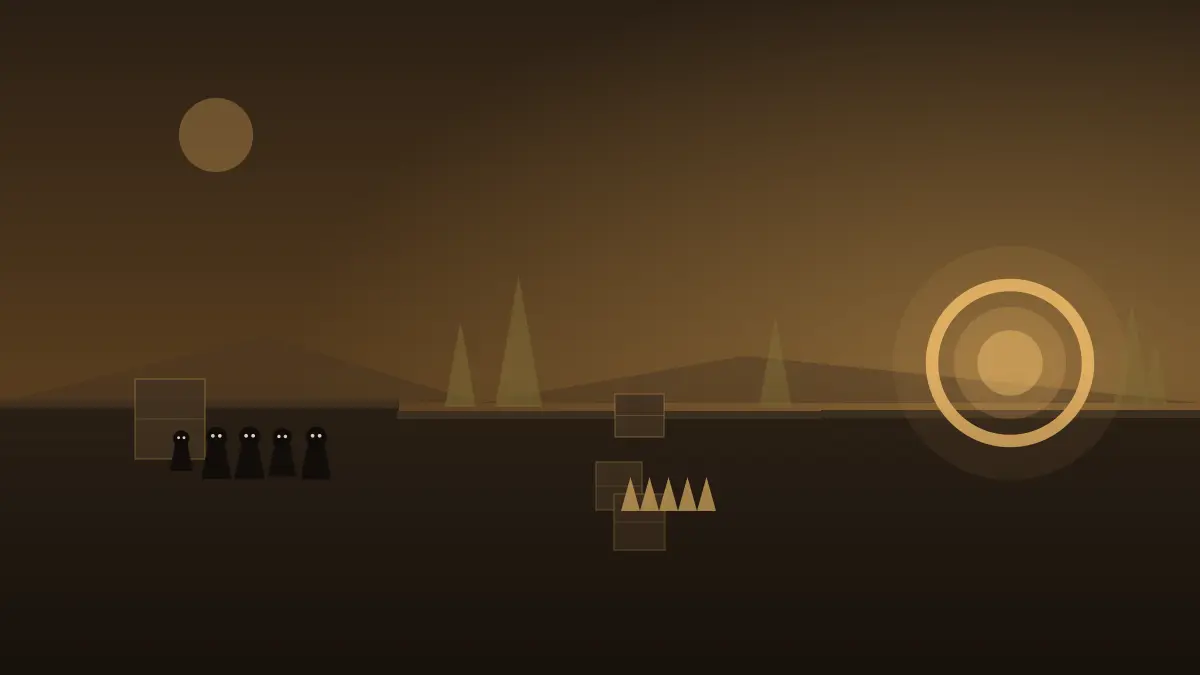
How does a Ritebound level actually work?
Every level gives you the same four tools and a hard cap on each one. The build bar at the bottom of the screen shows five slots: a square box, a horizontal plank, a vertical support, a trampoline, and a fifth slot that stays locked in the footage released so far. Under each slot is a small skull counter. That counter is the real difficulty knob — a level with three bridges is a different puzzle from a level with one.
The level plate in the top-left corner carries the level number and a box icon, and the top-right corner holds a speed multiplier plus a restart button. Those two controls tell you what the designers expect: you will replay levels, and you will want to watch the same mistake at 2× or 3× speed instead of walking it again at 1×.
The cultists themselves are simple. They spawn at a wooden door, walk in a line, and follow whatever surface is in front of them. When the route breaks, the front cultist stops and a question mark appears above their head. That question mark is the most useful diagnostic in the game: it tells you the failure is pathing, not timing.
Official screenshots show a desert level on plate 3, an autumn level on plate 10 and a snow-and-ice level on plate 12. The four biomes are real, but they are not handed out in ten-level blocks. Do not assume level 21 is the desert because a guide told you the biomes rotate in order.
What order should you place pieces?
Place the last piece first. That sounds backwards, so here is the reasoning: the final placement is the one the cultists reach last, and it is the one that has to survive the whole queue walking over it. If you spend your only bridge early because the first gap looks scary, you will arrive at the last gap with a square box that is too short.
A workable routine, in order:
- Pan the level and count the gaps that are wider than one square box.
- Count the ledges that are higher than one box stacked on the ground.
- Compare those two counts against your skull counters.
- Reserve the bridge for the widest gap, the support for the tallest ledge, and the trampoline for the one place where height has to be gained without a staircase.
- Place from the portal backwards.
If the counts do not fit the budget, the level is not asking you to build every crossing. It is asking you to reroute the queue so it only crosses once. That reroute is usually a single box placed as a wall, not a floor.
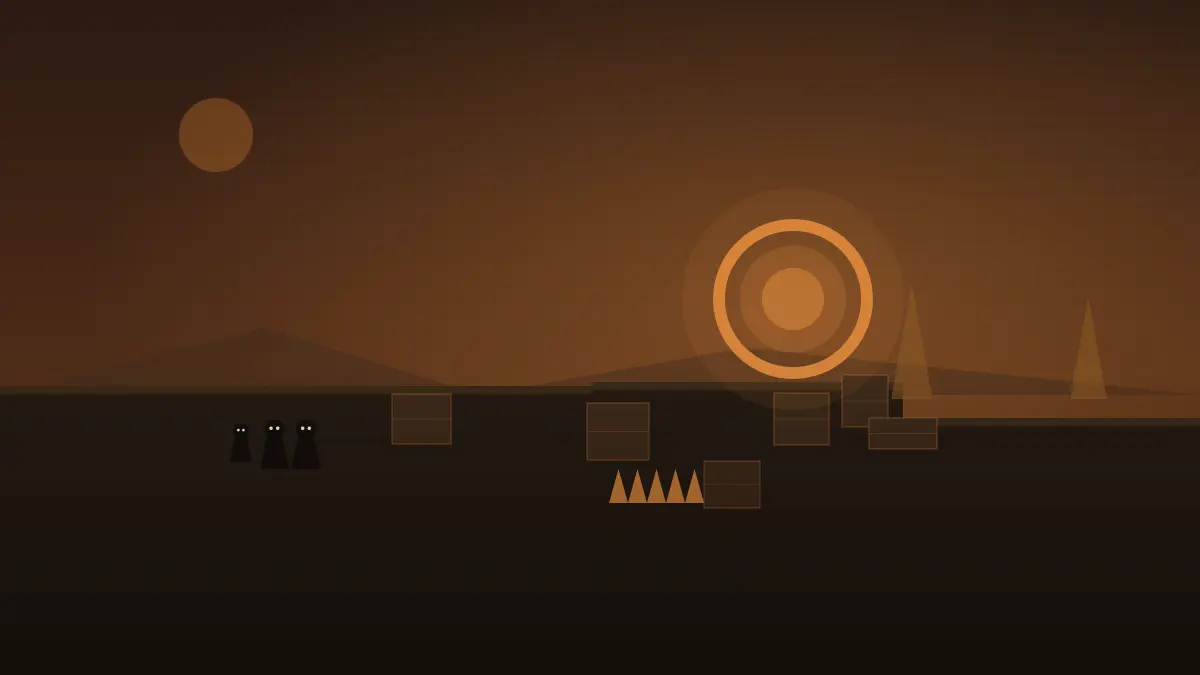
Which block of levels are you stuck in?
The site splits the run into four pages of ten levels, because the difficulty curve changes at each boundary. Levels 1-10 are teaching levels: one new tool at a time, generous counters, and pits that only punish a badly ordered build. Levels 11-20 start combining tools in the same level and shrink the counters. Levels 21-30 are the budget squeeze, where a wasted plank costs the run. Levels 31-40 assume you already think in reverse and punish any placement that leaves the queue without an exit.
- Opening decade, plates 1-10: Ritebound Levels 1-10 Walkthrough: First Boxes →
- Middle decade, plates 11-20: Ritebound Levels 11-20 Walkthrough: Bridges →
- Budget decade, plates 21-30: Ritebound Levels 21-30 Walkthrough: Tight Budgets →
- Final decade, plates 31-40: Ritebound Levels 31-40 Walkthrough: Final Portal →
Each of those pages gives a short solution per plate: what the level is testing, the placement order that works, and the specific trap that eats attempts. They are written as route notes rather than coordinates, because the useful thing to carry into a retry is the order, not a pixel position.
What ends runs most often?
Three things, in this order: spending the bridge on the wrong gap, letting the queue walk into a spike strip while you are still building ahead of them, and treating a trampoline as a shortcut when it is actually the only way to reach a ledge you have not scouted.
The trap catalogue matters more than it looks. Ritebound uses a small set of hazards — ground spikes, bottomless crystal pits, gargoyle heads that block a corridor, mist-covered water, and ice that changes how far a cultist slides. Each one has a different fix, and the fix is rarely "build higher". The traps guide → walks through each hazard with the placement that neutralises it.
The cultists keep walking while you place pieces. If you are three placements into a plan and the front of the line is already at the gap, you will lose the run to a fall, not to a bad plan. Pause the speed multiplier to 1× while you build, and only push it up once the route is complete.
Do the 40 levels play the same on every platform?
Yes. The level count, the tools and the four biomes are identical across PC, PlayStation 5 and Switch — the stores describe the same 40-level structure, and nothing in the listings suggests platform-exclusive levels. What differs is the wrapper: the Switch version lists eight languages and a 207 MB install, the PS5 version lists a smaller subtitle set, and the PC version has not been given a release date yet.
That last point is worth stating plainly, because it is easy to get wrong in a walkthrough written in advance: the Steam page for Ritebound is live, but it still shows a coming-soon state with no release date. The PS5 version arrived on 20 November 2026 and the Switch version on 19 November 2026, both at $9.99. If you are reading this on PC and the store still says coming soon, nothing is broken — the page exists, the date does not. The release and platform page → tracks the three listings separately.
What should you do before a retry?
Reset the level instead of salvaging a half-built route. The restart button is in the top-right corner next to the speed control, and it costs nothing. Half-built routes are the main source of "impossible" levels: a box placed for a plan you abandoned becomes a wall the queue cannot pass, and the question mark above the front cultist sends you looking for a trap that is not there.
Before you place anything on the retry, say the order out loud: bridge on the wide gap, support under the high ledge, box as a step, trampoline last. If the order does not survive contact with the counters, the level wants a reroute, not more pieces.
Official source: Ritebound on Steam ↗
Sources
Level structure, level count and platform details on this page come from the official listings rather than from a data dump: Ritebound on Steam ↗, the PlayStation Store page for PPSA40099 ↗ and the Nintendo eShop entry ↗.
Official source: Ritebound on Steam ↗
FAQ
How many levels does Ritebound have?
Forty, plus a tutorial plate that reads 0. The store description on Steam states 40 levels across four biomes (Autumn, Winter, Desert and Summer), and the PS5 and Switch listings describe the same structure.
Can you control the cultists directly?
No. You place boxes, bridges, supports and trampolines; the cultists walk the route on their own. Your input is the build budget and the order you spend it in, which is why a route that looks correct can still fail when the queue reaches a gap you built for a different plan.
Does Ritebound have a speed control?
Yes. The top-right corner of the screen shows a speed multiplier (the build seen in official screenshots is localised, reading "Скорость ×1") next to a circular restart button. Raising it speeds up the simulation, which is useful for testing a route and painful for judging a jump.
Is there a PC release date yet?
Not yet. The Steam page is published with system requirements and a store description, but the release date field still reads coming soon. The PS5 and Switch versions are already on sale at $9.99.